Recent international headlines (https://www.bbc.co.uk/news/articles/cdr457lxr71o) have once again drawn global attention to South Africa. Much of the public conversation has focused on politics, ideology, and competing narratives. But beneath the noise lies a far more urgent and human crisis – one that receives far less attention.
The real danger is not political rhetoric.
The real danger is what happens when already fragile health systems are weakened.
For children and adolescents living with HIV, the consequences can be devastating.
South Africa remains home to one of the largest HIV treatment programmes in the world. Over decades, extraordinary progress has been made through the combined efforts of government, healthcare workers, civil society organisations, communities, and international donors. Millions of lives have been saved. Mother-to-child transmission has dropped significantly. More children are surviving, growing, and reaching adolescence with hope for healthy futures.
But these gains are not self-sustaining.
They depend on functioning systems.
They depend on clinics having trained staff.
They depend on laboratory systems working efficiently.
They depend on data systems identifying children who are missed.
They depend on caregivers receiving support.
They depend on community health workers tracing those lost to follow-up.
They depend on mentorship that helps healthcare workers manage complex paediatric HIV cases.
When funding decreases, these systems weaken – often quietly at first.
The first losses are rarely medicines. Antiretroviral drugs may still be available on shelves. The deeper damage happens in the systems surrounding treatment.
A child may miss a viral load test because no one flagged it.
A baby with a positive PCR may not be traced quickly enough.
An adolescent struggling with disclosure may stop taking medication in silence.
A caregiver overwhelmed by poverty, stigma, or mental health challenges may disengage from care.
This is where children are lost.
Not because treatment does not exist.
Because the system fails to hold them.
Children and adolescents are among the most vulnerable populations affected by HIV because they are entirely dependent on others: caregivers, healthcare workers, schools, and health systems – for survival and long-term treatment success.
Unlike adults, a child cannot independently manage appointments, understand viral suppression, or advocate for treatment changes.
Paediatric HIV care is also inherently more complex.
Medication doses must be adjusted as children grow. Disclosure must happen carefully and age-appropriately. Adolescents face unique psychosocial pressures – stigma, identity struggles, mental health challenges, and treatment fatigue. Viral load fluctuations are common, even in children previously stable on treatment.
These are not challenges solved by medicine alone.
They require sustained support.
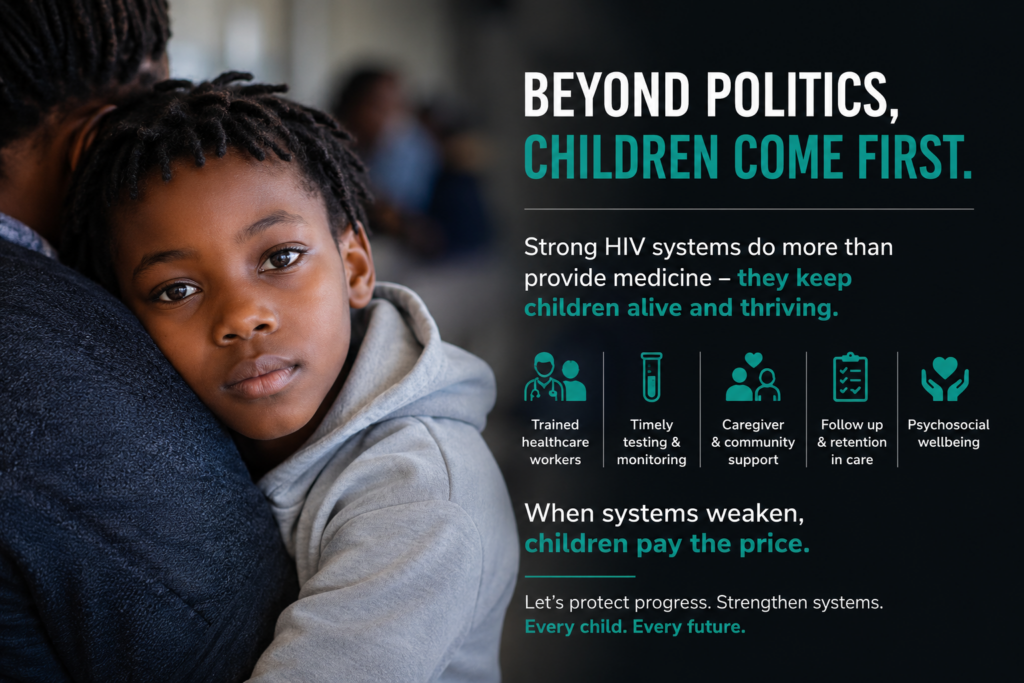
This is why systems strengthening matters so profoundly.
At CHIVA Africa, we have seen firsthand that the difference between treatment success and treatment failure often lies not in access to medication, but in the quality of support around the child.
When healthcare workers receive mentorship, clinical decision-making improves.
When district data systems function well, high-risk children are identified earlier.
When psychosocial support is available, adherence improves.
When caregivers feel supported rather than judged, children remain in care.
Strong systems save lives.
Weak systems cost lives.
This is particularly relevant now as shifts in global funding threaten programmes that have historically supported HIV service delivery across South Africa. Reduced external funding places immense pressure on an already overstretched public health system.
The impact is rarely immediate headline news.
Instead, it appears months later in troubling indicators:
- More missed viral loads
- More children lost to follow-up
- Rising unsuppressed viral loads
- Delayed infant diagnosis
- Increased advanced HIV disease
- Preventable illness and death
And once these gains are lost, rebuilding is costly and slow.
South Africa has made remarkable progress in HIV care, but the work is far from finished.
Too many children are still not virally suppressed. Too many adolescents struggle with lifelong adherence. Too many HIV-exposed infants remain vulnerable in the critical first 1,000 days of life.
We cannot afford to retreat now.
This is the moment to invest more strategically; not less.
We need stronger district-level systems.
We need better data visibility.
We need investment in healthcare worker mentorship.
We need integrated psychosocial support.
We need community-based follow-up that ensures no child disappears from care.
Most importantly, we must remember this:
Every statistic represents a child.
A child who deserves to grow up healthy.
A child who deserves a future beyond HIV.
A child whose survival should never depend on politics or funding cycles.
If we are serious about ending AIDS as a public health threat by 2030, we cannot focus only on treatment access. We must protect and strengthen the systems that make treatment possible.
Because when systems fail, children pay the price.
And when systems are strengthened, children do more than survive.
They thrive.
No child should die from HIV when the knowledge, treatment, and tools to prevent it already exist.
To invest in our work please see link below
https://donorbox.org/no-child-should-die-from-hiv


 Dr Mo Archary is a Paediatric Infectious Diseases Specialist at King Edward VIII Hospital, Durban and the University of KwaZulu-Natal: Nelson R Mandela School of Medicine.
 Shaun became a trustee for CHIVA Africa in February 2019. He is a South African qualified lawyer and holds the position of Chief Legal Officer at Cairn Capital, a leading European asset manager.
 Fiona joined the Board at CHIVA Africa in 2019. Fiona studied Law at Oxford University and started her career as a Barrister practicing in Chancery chambers before moving into financial services.
 Lauren joined the board in 2019, and is a lawyer by training and built a successful legal career in South Africa, specialising in public interest and media law. Lauren has lectured in media law, ethics and public interest law and takes a special interest in furthering the cause of women and those disadvantaged in South Africa.
 Dr Moshal is the founder of CHIVA Africa and CHIVA South Africa and has chaired the CHIVA Africa Board of Trustees since its registration as a charity in 2009. Born and raised in South Africa, Karyn graduated in medicine from the University of Cape Town in 1988.